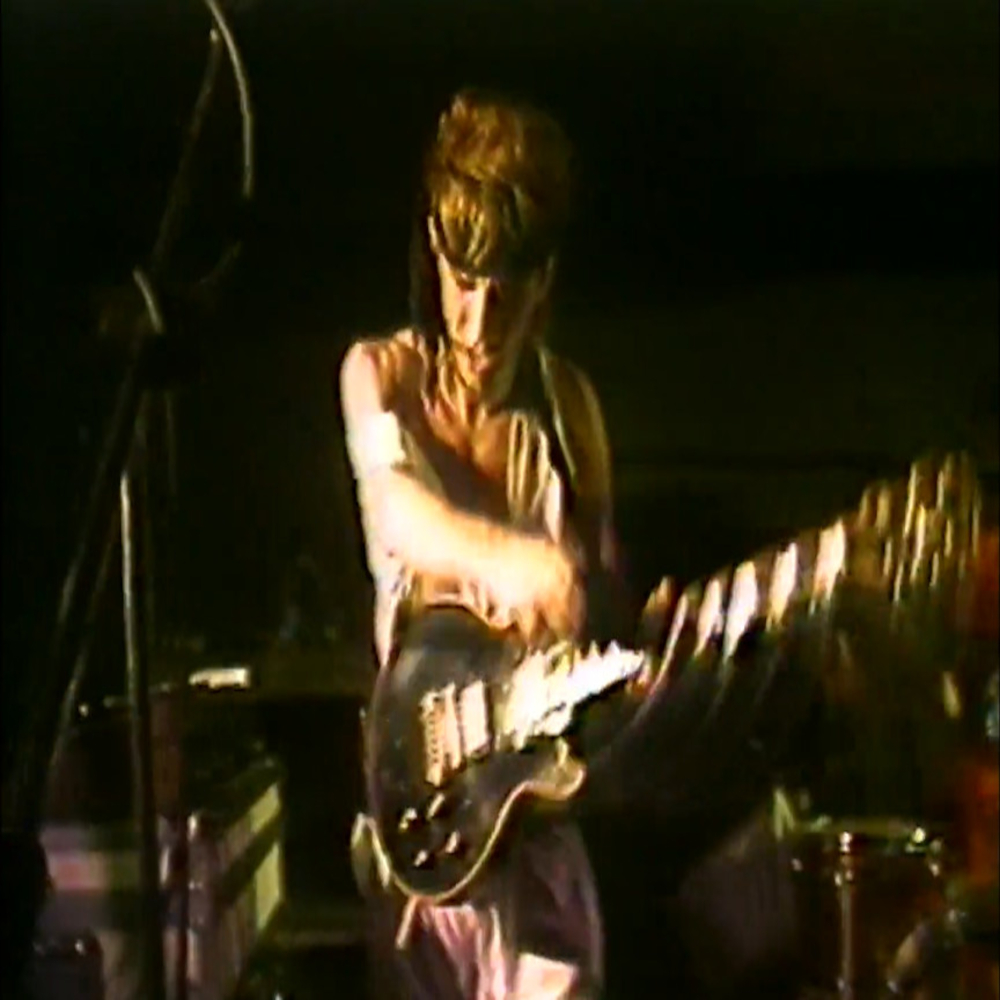
Guitar Faces

…journal of a practising musician…

Hello world!

Sticky Post
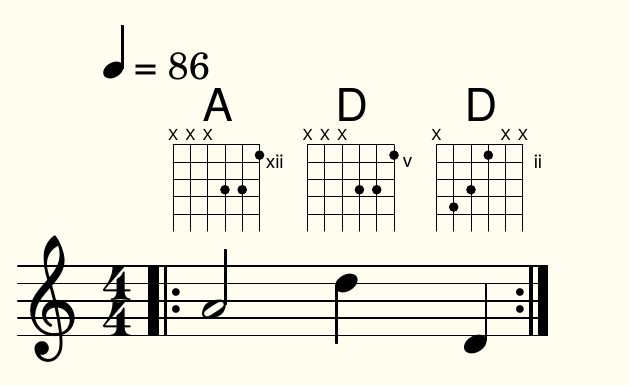
One measure of music marked to repeat "ad infinitum", at 86 beats per minute. The notes a, d and d appear, with guitar chord diagrams above the, also A, D, D.

Guitar Faces, as I quip frequently, is a music blog “for the practising musician” — meaning that even before the infamous pandemic, and despite a 16-year stretch where my guitar playing paid all my bills — I’ve arrived once again at a place in my life where I do a lot more practising than performing. But I was surprised and dismayed when old foils like stage fright and writer’s block threatened to return. How could this be happening… again?

That’s when I learned about undiagnosed adult ADHD. It err, struck a chord with me. In a windmill down stroke worthy of Townsend (or Cervantes) so much of my experience attempting a career in music fell into place. Getting a grip on my innate inattention, impulsivity and hyperactivity is improving my playing.

Reinvesting in myself is the word I want to use for it, not reinventing. My spiritual quest, if you will, has always been to be the best me I can be…

Reinvesting in myself is the word I want to use for it, not reinventing. My spiritual quest has always been to be the best me I can be, which has always in some way meant being the best guitarist I can be—since I was 14. Neurofeedback, at 63, enabled me to experience meditation in ways that eluded me a lifetime. Meditation now informs my guitar practice.

Keeping a journal is a highly recommended strategy for all professionals, regardless of their place on the neurodiversity spectrum. This journal is primarily for me; you are invited to look, see and engage as much or as little as suits you. My production services will always remain competitive. My experiences and the story of my journey will always be free.

Now… about those faces

E Pluribus Unity – Beginning the World Again

About my new song – coming March 11!

Out of many, one.

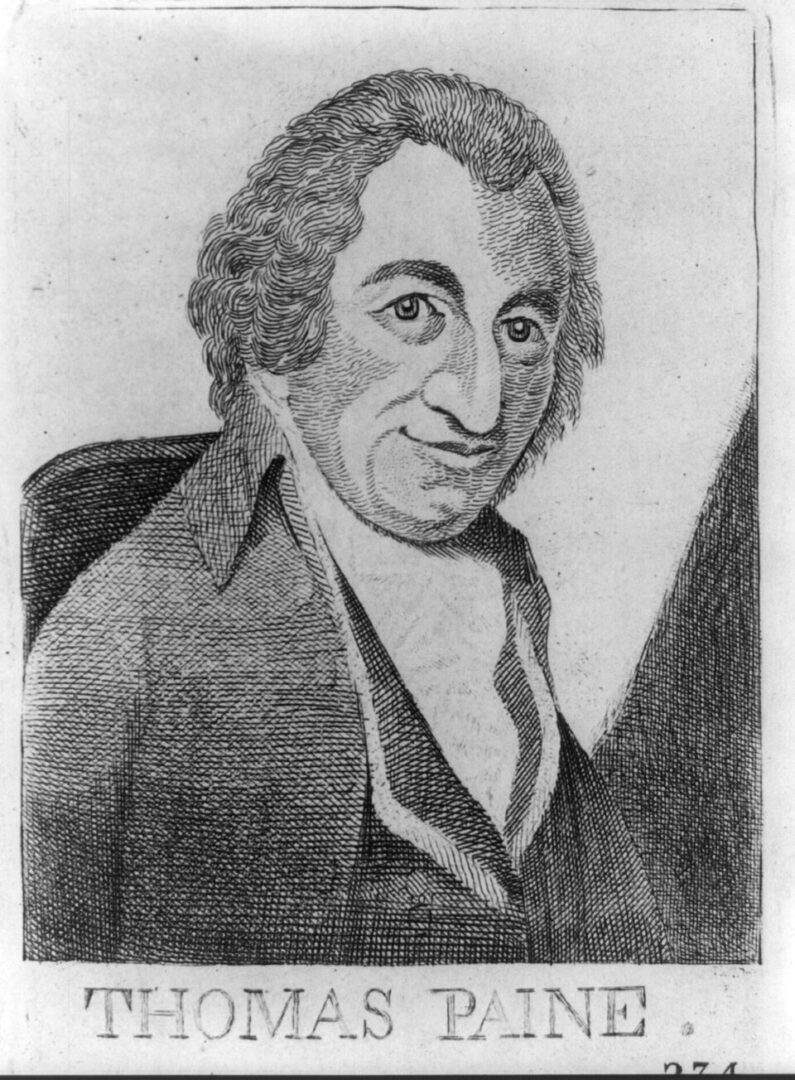
Etching of Thomas Paine, by John Kay, 1790.
Thomas Paine 1790
John Kay, artist (1742-1826), Public domain, via Wikimedia Commons

Me, approximately age 6: “Dad, what does ‘e plurib…’ this, on the dollar bill, mean?” If you’ve ever met my father you know you’ll always get far more than just the answer you were looking for. That particular day I heard that it was an early motto of the country we both happened to be born in, but not the official motto. That was also printed on our money: “In God we trust,” which I’m certain he followed, as ever, with, “…all others pay cash.”

Hope and promise — the stuff of song

I was raised to believe that E Pluribus Unum meant something more than its translation. It was an expression of hope, a promise to become whole — and better than what had come before.

Not that it perfectly described reality. It clearly did not. American liberty did not extend to everyone in 1776, nor in 1876, not in 1965, ’84… in fact, it never has. But it named an aspiration: out of many, one. Not sameness. Not uniformity. Unity.

That aspiration fascinated me that day, and filled me with hope, long before I wrote any song — half a lifetime, to be precise; I wrote my first two songs at age 9! I’ve written many songs since, and though many years later it remains a fact that few have heard them, I continue writing. It’s now the 21st century, and though I don’t have a flying car, like George Jetson, I have a digital audio workstation (DAW). I’m learning how to fly.

My newest song, “E Pluribus Unity – Diversity is Strength” began, musically and lyrically, at a cosmic scale. The verses step back from our self-importance entirely. They consider the age of the Earth, the span of human history, the size of the Milky Way. Against 13.8 billion years, our ideological quarrels are microscopic. Against the breadth of a galaxy, our tribal anxieties seem almost fragile. And yet — within our brief span — we often allow them to matter immensely.

To begin again

It is possible to hold both thoughts at once: that we are cosmically small, and morally consequential. That tension led me back to 1776. When Thomas Paine published Common Sense, he was not writing from a position of comfort. The outcome of the American experiment was far from certain. Fear was not irrational; it was pervasive. Empire was powerful. Independence was dangerous. And yet Paine wrote:

“We have it in our power to begin the world over again.”

I adapted portions of that passage for the bridge of this song — compressing, omitting, reshaping — trying to preserve its force within a fourteen-bar section. The line that stayed with me most was this idea of beginning again. Not perfecting the old world. Not retreating into it. Beginning anew.

Paine’s rhetoric was not gentle. In The Crisis he went further, naming fear as the foundation of reaction, even writing: “Every Tory is a coward; for servile, slavish, self-interested fear is the foundation of Toryism…” Eighteenth-century polemic was not subtle!

To be governed by fear, or by vision?

Beneath the invective was a psychological claim: that contraction, exclusion, and smallness are often rooted in fear. Paine believed the revolutionary project required courage — not merely military courage, but imaginative courage.

Every era confronts the question: will fear govern us, or will vision? The theme feels contemporary without being partisan.

Theme to music

For the songwriters and musicians who may be reading, while everything I’ve ever done begins with improvisation, when I’m with it, the DAW lets me capture much I once let get away. I thought this one out: the verses and chorus live in A Major — grounded, stable, almost luminous. In the bridge, the harmony shifts abruptly into C Mixolydian. There is no careful preparation. The floor moves. The tonal center relocates. It destabilizes before it resolves. That move was not accidental.

Revolutions — personal or political — rarely arrive politely. They interrupt. They displace. They challenge the security of what felt settled.

And then, if they are to endure, they must integrate. The harmony finds its way home again — not unchanged, but clarified. The guitars and the Mini Moog trade phrases like a small ensemble arguing toward coherence, and before the conversation ends they speak in unison.

Out of many voices, one line.

That unison is not uniformity. The timbres remain distinct. The instruments do not become each other. But they converge.

I am under no illusion about the historical contradictions embedded in the founding era. The rhetoric of liberty coexisted with slavery, dispossession, and exclusion. The American story has always been morally unfinished.

But I was raised to believe that the aspiration itself — the expansive language of equality and shared destiny — matters. That the ideal exerts pressure on the reality. That it calls nations and humanity forward rather than to fall backward.

The dream is over
What can I say?
The dream is over
Yesterday
I was the dream weaver
But now I’m reborn
I was the Walrus
But now I’m John
And so, dear friends
You’ll just have to carry on…

John Lennon

So dear friends, shall we carry on?

The question, nearly 250 years later, is not whether the experiment was flawed. It was. The question is whether we still believe in expansion rather than contraction. Whether diversity is a threat to be managed or a strength to be woven into unity.

Against the scale of the universe, our fears are small. But within the narrow bandwidth of our lives, they can shape everything.

Paine believed ordinary people possessed the power to reimagine their political world. He believed imagination was not naive — it was necessary.

The universe is larger now than he knew. We are smaller within it than we once imagined. And yet his assertion remains unsettling:

We have it in our power to begin the world over again.

“We have it in our power to begin the world over again. A situation, similar to the present, hath not happened since the days of Noah until now. The birthday of a new world is at hand, and a race of men, perhaps as numerous as all Europe contains, are to receive their portion of freedom from the events of a few months. The reflection is awful, and in this point of view, how trifling, how ridiculous, do the little paltry cavilings of a few weak or interested men appear, when weighed against the business of a world.”
— Thomas Paine (1776), Appendix to Common Sense

That line does not belong to 1776 alone. It belongs to any generation willing to claim it.

My newest song, “E Pluribus Unity – Diversity is Strength” will drop March 11.

§

E Pluribus Unity – Diversity is Strength

Verse

Have you contemplated the age of our Mother Earth?
And all the life that grew before we appeared
Paved our way to birth?

Have you not considered the size of the Milky Way?
Have you stood in the eye of the hurricane and
Counted stars that way?

Chorus

Diversity is strength
Equity means fairness
Inclusion builds community
Awakening awareness
Dignity, respect
Or simply say “good manners”
Each culture has its Golden Rule
Let’s build a better world

Verse

Have you anticipated A time when we all can be free
To live and love without facing judgement
For whom we’ve come to be?

Bridge

[The birthday of a new world ]
We have it in our power to begin the world again…
[How trifling, how ridiculous … ]
The little paltry cavilings of a few weak … men appear,
when weighed against the business of a world.”

Choruses out

Diversity is strength
Equity means fairness
Inclusion builds community
Awake in bright awareness
Dignity, respect
And mutu’l understanding
Each culture has its Golden Rule
Let’s build a better world

© Word & Music 2026 Richard Fouchaux/GuitarFaces Music All rights reserved

About “The Lion Sleeps Tonight”

Miriam Makeba did not make this song famous internationally. The Tokens did, in 1961. Its origins lie with South African Zulu musician Solomon Linda and The Evening Birds’ “Mbube,” in 1939. Moreover, the song’s history is actually a case study in cultural appropriation and exploitation, which later became a political issue in its own right.

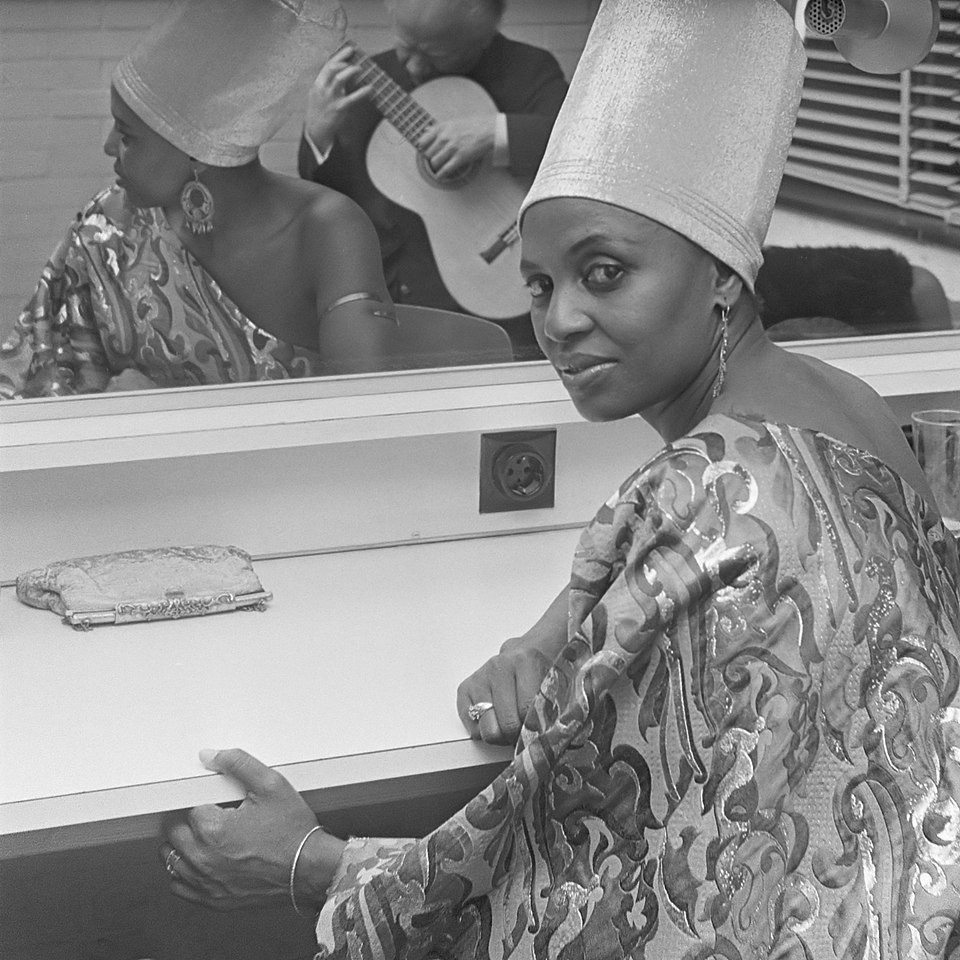
Miriam Makeba in her dressing room, wearing traditional headgear, 1969.
1969/03/07 Rob Mieremet / Anefo Nationaal Archief
Public Domain Dedication (CC0)

But if The Lion Sleeps Tonight is the Miriam Makeba you know best, it’s understandable. And yet—it’s diametrically opposed to her importance, as an artist and as a South African.

A witness in exile

Miriam Makeba’s singing often functions like testimony rather than persuasion. She was apartheid’s witness in exile, attesting to its horrors, her words and music censored at home—her songs functioning as deposition rather than slogan. Once you see that, she’s impossible to misfile as merely “world music” — or 60’s nostalgia.

Life-risking testimony — not mere metaphor

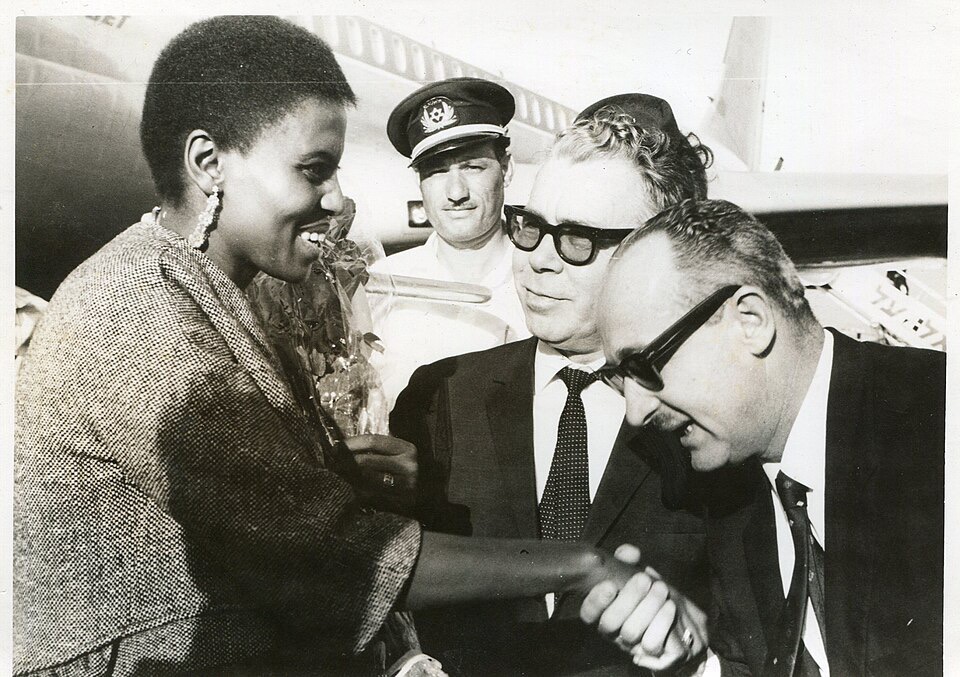
Jacob Ori welcomes Miriam to Israel 1963, kissing her hand as one does royalty, as she steps from the plane.
Jacob Ori + unknown
welcome Miriam to Israel (1963) Public Domain Dedication (CC0)

Miriam Makeba, Hugh Masekela, and others understood singing as life-risking testimony, not metaphor. To get to know the true Miriam, a rewarding next step is to listen to “Soweto Blues” and “Ndodemnyama” back-to-back, paying attention not just to lyrics but to delivery—how restraint itself becomes political. That’s where her power lives.

Hamba kahle, Miriam. Lala ngamandla, Miriam! Go well!

Pumzika kwa heshima — na nguvu, Miriam! Rest with dignity — and with power!

§

Whose Music Is This, Anyway?

Misattribution

I recently came across a quote attributed to Lao Tzu that immediately raised my suspicions:

“Music in the soul can be heard by the universe.”

It is a beautiful sentiment. It is also almost certainly not Taoist—and almost certainly not Lao Tzu.

Lao-tzu on music

The line has the familiar feel of a modern greeting-card aphorism: affirming, expressive, and quietly centered on the self. My doubts grew when I set it beside an authentic verse from the Tao Te Ching:

“The five colors blind the eye.
The five tones deafen the ear.
The five flavors numb the taste.”

(Chapter 12)

This is not a rejection of music, but it is a warning: refined sensation can interfere with perception rather than deepen it. Taoism, from the beginning, has been wary of confusing stimulation with insight.

That tension—between music as expression and music as interference—is where this reflection begins.

Three Kinds of Music

The Taoist thinker Zhuangzi, writing a generation or two after Lao Tzu, offers one of the most intriguing accounts of music in world philosophy. Zhuangzi lived during the Warring States period, around the 4th century BCE, and is credited with writing a work known by his name, the Zhuangzi, considered one of two foundational texts of Taoism, alongside the Tao Te Ching. He describes three kinds of music:

The Music of Man
The Music of Earth
The Music of Heaven

The Music of Man is what we usually mean by music: instruments, compositions, styles, genres, techniques, systems of taste. It is intentional, cultivated, and deeply human.

The Music of Earth is sound without human design: wind passing through valleys, trees, or hollow spaces, each producing different tones according to their shape. No composer. No audience. Just conditions giving rise to sound.

Then there is the Music of Heaven—the most elusive of the three. This is not “higher” music, nor sacred repertoire. It is the spontaneous resonance of things responding to one another without effort, ownership, or assertion.

Zhuangzi’s quietly unsettling question

Zhuangzi points to the innumerable voices of the world itself—sounds and forms arising spontaneously as conditions shift—which he calls the ‘ten thousand differences’: a boundless plurality in which nothing stands as the source, and everything emerges through relation rather than design. Zhuangzi poses a quietly unsettling question:

“Who is it that blows the ten thousand differences?”

The question undermines the assumption that sound must belong to someone. Even human music, he suggests, may participate in the Music of Heaven—but only when the insistence on authorship falls away.

Expression, Attunement, and a Familiar Modern Pressure

Much contemporary music culture—especially online—rests on an expressive model: music as self-disclosure, output, and signal. We are encouraged to publish constantly, iterate relentlessly, and trust that quantity leads to quality.

For many musicians, this approach is practical, even necessary. I have no quarrel with it, and no interest in disparaging those for whom it is fruitful.

But Taoism invites a different question: not how much music we make, but how music happens at all.

Zhuangzi is not concerned with productivity, consistency, or optimization. He is concerned with interference. The danger is not making too much music, but trying too hard to make music mean something—to assert, impress, compete, or declare.

This is where modern expressive ideals quietly diverge from Taoist thought. The Taoist concern is not authenticity or emotional honesty; it is attunement—the capacity to respond to the music itself, to its rhythms, silences, and subtleties, rather than imposing a will on it. Music goes astray when the self insists on being the source.

A Brief Detour: Confucianism and Buddhism

This Taoist position stands out more clearly when contrasted with two neighboring traditions.

Confucianism treats music as moral technology. Proper music cultivates virtue, stabilizes emotion, and reinforces social harmony. Music is valuable because it shapes people toward an ordered ideal. Zhuangzi’s skepticism toward standards of taste and harmony is, in part, a response to this instrumental view.

Buddhism, especially in its early forms, is wary of music as sensory pleasure—something that can foster attachment and distraction. Later traditions, particularly Zen, soften this stance. A bell, a clap, or a sudden sound can provoke awakening. Yet even here, sound ultimately points toward impermanence and non-attachment.

Zhuangzi’s position is different again. He does not treat sound as moral tool, nor as temptation, nor even as illusion. He treats it as unknowable. The problem is not sound, but the claim that it belongs to us.

Listening as Aspiration

This brings us back to the opening quote.

The idea that “music in the soul can be heard by the universe” assumes that our highest aspiration is to be heard—to project something inward outward, and have it recognized.

Taoism quietly reverses this direction.

In Zhuangzi, music does not elevate the human voice into the cosmos; it tests whether the human voice can fall silent enough to hear what is already sounding.

This is not a call to stop making music. It is a call to notice when music feels forced, anxious, or performative—when it feels like a claim rather than a response.

For some musicians, this perspective can feel alienating in a culture organized around metrics, output, and comparison. For others, it can feel like permission: to work slowly, to listen deeply, to trust intervals of silence, and to let music arise rather than be extracted.

Where I Stand (Quietly)

I do not believe there is one correct path. The Music of Man matters; skill matters; practice matters. But the Music of Heaven does not respond to pressure, volume, or ambition.

If this way of thinking resonates, you are not alone—even if it sometimes feels that way in competitive spaces. Taoism has been quietly offering this alternative for over two thousand years: not a rejection of music, but a refusal to hurry it, own it, or turn it into proof of worth.

Concluding remark

The universe does not need to hear our music. Perhaps the deeper aspiration is learning to listen, fully and quietly, as music arises.

Peace, my friends!

§
When Your DAW Freezes but Your CPU Is Fine: A Musician’s Introduction to LatencyMon

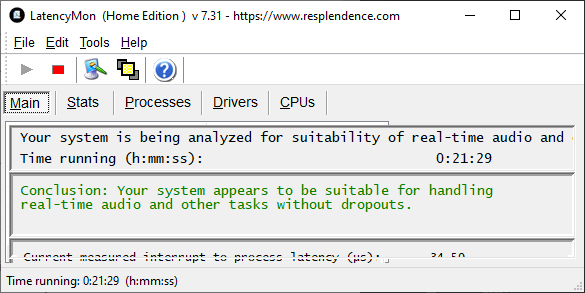
LatencyMon monitoring latency in Reaper on Windows 10, 2026/01/18

Latency — learning what to do about it

Step by step, in by inch

I assumed I understood audio latency on computers. Buffer size? Check. Sample rate? Check. CPU load? Keep it low, freeze tracks, print effects. I absorbed Kenny Gioia’s Adjusting Recording Latency (Loopback Test) in REAPER video, made the adjustments, and upgraded to an interface (Rubix44) with better monitoring abilities.

And yet… every so often — on machines that should have been fine — I’d get the dreaded symptoms: a DAW freeze, a sudden glitch, or that heart-stopping moment where audio just… stops responding.

The CPU meter wasn’t pegged. Disk activity looked normal. Nothing obvious was wrong. I chalked it up to “Windows being Windows” and moved on. And that worked… until it didn’t!

The Hidden Kind of Latency

What I’ve learned is that not all latency lives inside your DAW. There’s another layer — deeper, quieter, and far more insidious — called interrupt latency. This is about how quickly your system can respond to real-time events: audio buffers, MIDI messages, USB traffic, network activity.
When that layer misbehaves, your DAW can freeze even when everything looks fine.

Enter LatencyMon!

Download LatencyMon from Resplendence Software

What is it?

LatencyMon is a free diagnostic tool that doesn’t measure audio performance directly. Instead, it watches how your system handles interrupts and deferred procedure calls (ISRs and DPCs). If those spike too high, real-time audio suffers.

At first glance, LatencyMon can feel… unfriendly. Acronyms, scary red text, references to drivers you’ve never heard of. But with a little context, it becomes an incredibly empowering tool.

The Big Mental Shift: Chronic vs. Event-Driven Problems

Here’s the most important thing I learned: A system that runs clean for hours is not “bad.” A system that occasionally spikes has a trigger. This distinction changed everything.

If LatencyMon reports consistently high numbers, you may have a chronic configuration issue. But if it runs happily in the green for long stretches and then suddenly explodes? That’s almost always event-driven. Events that contribute to latency include:

  • Sleep/wake.
  • Display changes.
  • Network activity.
  • USB power management.
  • Audio devices you’re not even using.

Once I understood this, LatencyMon stopped feeling accusatory and started feeling like a detective’s notebook. And my system stopped freezing. Mixes I worked on ‘last night’ started running just the same the morning after.

The Usual Suspects (and Some Surprises)

In my case, the biggest offenders were not my audio interface or my DAW. They were things like:

  • Display audio drivers (HDMI / DisplayPort pretending to be speakers)
  • Unused onboard audio
  • Virtual audio devices I wasn’t actively using
  • USB power management quietly re-enabling itself
  • Network and ACPI activity during power state transitions

Disabling Intel Display Audio and unused Realtek audio alone dropped my worst interrupt spikes from tens of milliseconds to well under 50 microseconds. That’s not a tweak. That’s a revelation!

A Word About “Good” Numbers

After selectively disabling devices I didn’t need during recording, my system settled around 30–40 µs peaks. At that point, I stopped chasing numbers and started making music again.

LatencyMon doesn’t give you a single pass/fail score, but rough guidelines help:

  • Under 100 µs ISR/DPC peaks: excellent
  • Under 500 µs: solid
  • Over 1000 µs: worth investigating
  • Tens of thousands of µs: something is seriously misbehaving

After selectively disabling devices I didn’t need during recording, my system settled around 30–40 µs peaks. At that point, I stopped chasing numbers and started making music again. Which, frankly, is the goal.

Less Is More (Especially on Windows)

Every enabled audio device is something Windows feels responsible for managing, even if you’re not using it. You probably have some of these in plain sight:

  • Webcam microphones.
  • USB mics.
  • Virtual routing drivers.
  • Calibration “virtual devices.”

None of these are bad. But they don’t need to be present during a recording session. I now think of my system in modes:

  1. Recording mode: only the interfaces and drivers I need
  2. Meeting mode: webcams, virtual routing, USB mics
  3. General use: everything else

And I have a laptop at the ready to offload 80% of modes 2 & 3.

Disabling devices

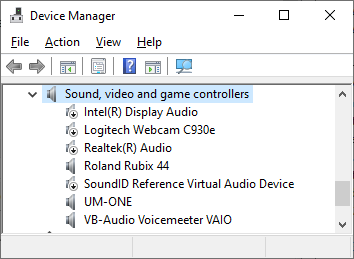
Recording mode: unused devices disabled. VB-Voicemeter is a virtual device I use to stream mixes in Zoom—a routing utility that doesn’t control hardware.

Disabling devices (not uninstalling them) takes seconds and removes entire classes of background activity. Open Device manager –> Sound, video and game controllers.

LatencyMon as a Learning Tool, Not a Stress Test

Used poorly, LatencyMon can make you paranoid. Used well, it teaches you how your system actually behaves. The key is not to panic over single spikes. Watch for patterns. Correlate spikes with actions. Change one thing at a time. Stop when the system behaves. And most importantly: don’t chase perfection. Chase stability.

Why This Matters for Musicians

We tend to blame ourselves when technology gets flaky.
“Maybe I pushed the buffer too low.”
“Maybe this plugin is unstable.”
“Maybe I need a new machine.”
Sometimes the problem isn’t musical or computational at all. It’s infrastructural. Understanding that — and knowing how to verify it — is deeply calming.

A Practical Takeaway

If you’ve ever stared at a frozen DAW wondering what just happened, learning to read LatencyMon — even a little — is worth your time.

It certainly was for me.

§

Does Every Culture Have Its Own Version of the Golden Rule?

People often say that every culture has its own version of the Golden Rule: “Do unto others as you would have them do unto you.” It’s a comforting idea—that human beings everywhere have discovered the same moral truth.  The short answer is that this is mostly true in spirit, but not identical in practice.  Almost every society has some form of reciprocal ethic, yet how it’s phrased, who it applies to, and what it asks of people can differ a great deal.

Across time and continents, the rule appears in two main forms.  One is positive: act toward others the way you’d like them to act toward you.  The other is negative: don’t do to others what you wouldn’t want done to you.  The positive form asks for kindness and initiative; the negative form simply warns against harm.  The negative version is actually older and more common—it’s easier to enforce “don’t hurt people” than “go out of your way to help them.”

In the Bible, both forms appear: the Jewish sage Hillel said, “What is hateful to you, do not do to your neighbor,” while Jesus rephrased it as “Do unto others…”  Islamic teachings echo the idea: “None of you truly believes until he wishes for his brother what he wishes for himself.”  Confucius, in ancient China, advised, “Do not impose on others what you do not desire for yourself.”  Buddhist and Hindu writings urge compassion and non-harm to all beings, and Jainism makes non-violence (ahimsa) its central rule.

In Africa, the philosophy of ubuntu—“I am because we are”—expresses mutual care and shared humanity.  Many Indigenous traditions around the world likewise emphasize reciprocity and balance within the community and with nature.  Even in secular Western philosophy, ideas of universal fairness appear: Aristotle’s virtue ethics, Kant’s “act only on that rule you could will for everyone,” and the modern concept of human rights all rest on the intuition that others deserve treatment comparable to our own.

Yet the details matter.  Some cultures apply these principles mainly to family, tribe, or fellow believers, not to strangers or enemies.  In hierarchical societies, the rule often takes a one-way form: subordinates owe obedience, while leaders owe protection—not equal reciprocity.  Others combine benevolence with retributive justice: “an eye for an eye” also reflects a sense of proportional fairness, though not kindness.

The Golden Rule also assumes that what you want is what others want.  That’s not always true across cultures or personalities.  A joke among ethicists says the Rule can backfire: a masochist following it would be a menace.  This doesn’t destroy the idea, but it shows that empathy must include imagination—understanding the other’s perspective, not projecting our own.

Another big difference is motivation.  In some traditions, the rule is divine command: God asks it, so obedience is moral.  In others, it’s practical wisdom: mutual respect keeps society peaceful.  In still others, it’s compassion for its own sake.  The common thread is social trust.  Communities survive when people can rely on each other not to exploit vulnerability.

If we step back, the convergence is striking.  From the Ganges to the Mediterranean to the African savannah, humans discovered that cooperation and restraint make life bearable.  This doesn’t mean every civilization preaches identical universal love.  It means that wherever humans have lived together, they’ve had to find language for fairness, empathy, and mutual obligation.

So, does every culture have the Golden Rule?  In some form, yes.  As a literal, universal command to treat all people alike, not quite.  The spirit—“recognize yourself in others”—shows up almost everywhere, but it’s filtered through local customs, religions, and power structures.  The idea’s persistence is a clue that moral imagination—the ability to see oneself in another’s place—may be one of humanity’s oldest survival skills.

If we take that lesson seriously, the Golden Rule stops being a slogan and becomes an ongoing practice: the effort to keep widening the circle of “others” who count as “us.”

§

…and now with that in mind…

Protest songs are the greatest songs

The songs I grew up on were often “political.” Well, maybe not Chewy Chewy (but I think you might make a case for Another Pleasant Valley Sunday). I grew up on the east coast of the U.S.A. in the 60s, and they were political times. Before I heard either of those I’d heard Pete Seeger, Woody and Arlo Guthrie — Blowin’ in the Wind is one of the first songs I learned on guitar, age 9. Like all my friends, I knew every word of Drug Store Truck Drivin’ Man once the Woodstock album came out.

But it was rock songs like Volunteers of America, Won’t Get Fooled Again, Fortunate Son, I Don’t Wanna Be a Soldier, Mama (Imagine, Working Class Hero, Give Peace a Chance)… that made me want to be a songwriter.

Writers penned songs calling for radical change, resistance to the establishment, and active participation in a counter-cultural movement. Titles like these were rallying cries for young people to rise up against societal injustices, particularly in the context of the Vietnam War, civil rights struggles, and broader dissatisfaction with the political and social order of the time.

Volunteers‘s tone is defiant, urgent, and idealistic, urging listeners to take action rather than passively accept the status quo. The aggressive electric guitar, pounding drums, and impassioned vocals amplify the sense of rebellion, making it one of the Airplane’s most politically charged songs.

you’re still fucking peasants as far as I can see

—John Lennon, Working Class Hero

Working Class Hero is a more stripped-down, cynical, and biting tone, and well, the F word was still a big deal — a dare perhaps? No energetic call to action, Lennon’s song is a bleak, acoustic folk ballad that lays bare the psychological oppression of the working class. His lyrics describe a society that systematically crushes individuality and keeps people in line with false promises of success. It’s among the most brutally honest and confrontational protest songs of all time.

Relevance?

No single factor guarantees that a song will endure; rather, it’s the synergy among emotional depth, cultural moment, artistic innovation, and personal connection that elevates certain songs above the rest. A song’s significance often resides in its depth of meaning and craftsmanship, while its relevance is tied to how it speaks to current experiences and continues to find new life through reinterpretation and rediscovery.

Originally dedicated to Greenland and the Faroe Islands, Björk’s Declare Independence (from Volta, 2007) became a fierce anthem encouraging oppressed peoples to break free from controlling powers in Kosovo, Tibet and everywhere people found its message relevant: “Declare independence — Don’t let them do that to you !”

I never thought of myself as a singer or a musician. I just had something to say.

— Leonard Cohen

Trying overtly to be profound will almost always make a song stiff …pretentious or didactic. “The better songs are often ones where the meaning is ambiguous. That allows people to find their own resonance,” says David Byrne. “The music has to feel right, and then meaning finds its way in.” Or Joni Mitchell: “I don’t set out to be deep. I set out to be truthful.” When you have something to say and you say it well, people listen.

Raising my flag

At this point in life I don’t imagine myself writing songs with the impact of the artists I’ve named here. I just love to play my guitar. Sometimes I have things I’d like to say, and sometimes I try to say them well in a song. It seems like it may be time once again to overcome, and we shall. I shall overcome the things holding me back up until now.

“Avoiding” politics is political

Choosing to be apolitical is often seen as a neutral or passive stance, but in reality, it is a political act with significant consequences. Every society operates within a structure of power, laws, and cultural norms, and refusing to engage with these systems does not make them disappear. Instead, it allows the existing structures—whether just or unjust—to persist unchallenged. In this way, apathy is not a withdrawal from politics but an implicit endorsement of the status quo. As the saying goes, “The only thing necessary for the triumph of evil is for good men to do nothing.” By choosing not to participate, one surrenders decision-making to those who are most active, whether they be visionaries or oppressors.

Throughout history, it has been the inaction of those who could have acted, the indifference of those who should have known better, the silence of the voice of justice when it mattered most, that has made it possible for evil to triumph.

Haile Selassie (Speech to the United Nations, 1963)

Moreover, in societies where injustice exists, silence and inaction function as forms of compliance. When individuals refrain from voting, speaking out, or advocating for change, they create space for the most dominant voices—often those with power, wealth, or coercive influence—to dictate the direction of society.

In a world where authoritarian tendencies, corporate interests, and social inequalities shape policy, choosing to be apolitical is effectively choosing to let these forces act unchecked. It is a surrender not just to the status quo, but to the strongest and most aggressive players within it. It favours the bullies.

Some may argue that they avoid politics to maintain peace of mind or focus on personal matters, but even this is a political position. It reflects a belief—whether conscious or not—that one’s personal well-being is separate from the collective struggles of a society. However, policies affect everything from education and healthcare to employment and civil rights. To ignore them is to risk being blindsided by changes that impact one’s life and the lives of others.

Ultimately, the choice to be apolitical is not an escape from politics but a decision to let others determine the future—often those with the most self-serving agendas. In this sense, inaction is not neutrality; it is an act of surrender.

Here are twelve quotes from diverse thinkers, activists, and leaders that support the idea that being apolitical is, in itself, a political act:

1. Paulo Freire (1921–1997, Brazil, educator and philosopher)

“Washing one’s hands of the conflict between the powerful and the powerless means to side with the powerful, not to be neutral.” (Pedagogy of the Oppressed, 1968)

2. Dr. Martin Luther King Jr. (1929–1968, USA, civil rights leader)

“He who passively accepts evil is as much involved in it as he who helps to perpetrate it. He who accepts evil without protesting against it is really cooperating with it.” (Stride Toward Freedom, 1958)

3. Desmond Tutu (1931–2021, South Africa, anti-apartheid activist and cleric)

“If you are neutral in situations of injustice, you have chosen the side of the oppressor.”

4. Elie Wiesel (1928–2016, Romania/USA, Holocaust survivor and writer)

“We must always take sides. Neutrality helps the oppressor, never the victim. Silence encourages the tormentor, never the tormented.” (Nobel Peace Prize speech, 1986)

5. Alice Walker (b. 1944, USA, author and activist)

“Activism is the rent I pay for living on this planet.”

6. Angela Davis (b. 1944, USA, political activist and scholar)

“In a racist society, it is not enough to be non-racist. We must be anti-racist.”

7. Simone de Beauvoir (1908–1986, France, philosopher and feminist)

“Change your life today. Don’t gamble on the future, act now, without delay.”

8. Pericles (c. 495–429 BCE, Greece, Athenian statesman)

“Just because you do not take an interest in politics doesn’t mean politics won’t take an interest in you.”

9. Haile Selassie (1892–1975, Ethiopia, Emperor and anti-colonial leader)

“Throughout history, it has been the inaction of those who could have acted, the indifference of those who should have known better, the silence of the voice of justice when it mattered most, that has made it possible for evil to triumph.” (Speech to the United Nations, 1963)

10. Toni Morrison (1931–2019, USA, author and Nobel laureate)

“The function of freedom is to free someone else.” (Commencement speech at Barnard College, 1979)

11. Howard Zinn (1922–2010, USA, historian and activist)

“You can’t be neutral on a moving train.” (Book title, 1994)

12. Arundhati Roy (b. 1961, India, writer and activist)

“The only thing worth globalizing is dissent.”

These quotes collectively highlight the idea that inaction, neutrality, or apathy in the face of injustice and power structures is itself a political choice—one that ultimately benefits the oppressor over the oppressed.

§

Breathe, and it shall be given

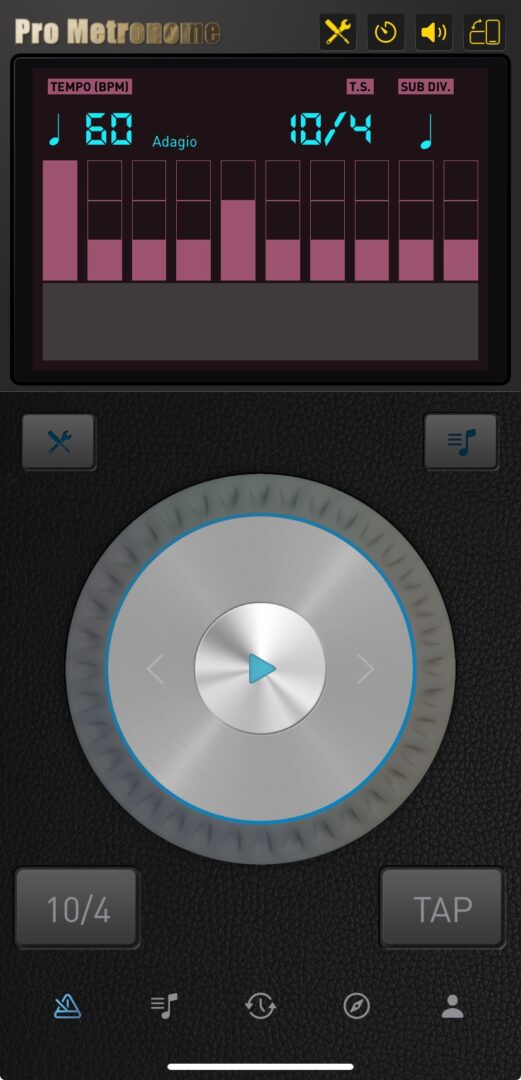
Pro Metronome app with settings for 4:6 regulated breath control. Tempo 60, time signature 10/4, subdivision quarter notes. There's a strong accent set on Beat 1, and a lesser accent on Beat 5.
Pro Metronome — “The best metronome app. Period.” Those are their words, but I don’t disagree. These settings will help you do 4:6 breathing. See below…

Breath control is life control

When I was diagnosed with ADHD I learned there’s solid scientific evidence that controlled breathing techniques can improve focus, help regulate emotions, and reduce stress. While these are all factors that are particularly relevant for managing ADHD, the knowledge is ancient and has benefited the human family for centuries.

4:6 — the golden ratio of breath control

With diaphragm engaged, Inhale for 4 seconds, exhale for 6, through your nose. You will take 10 breaths each minute. Butterflies disintegrate. Anxiety melts away. If you practice several times a day, in about 3 weeks it will become easy.

This is not new!

The integration of biofeedback into ADHD management is, in many ways, a scientific rediscovery of wisdom that has guided monks, yogis, and meditators for millennia. What is new is our ability to measure and fine-tune these techniques with modern tools, offering personalized, data-driven approaches to cultivating focus and self-regulation. For musicians like me, this has a direct impact not only on mental clarity but also on technical precision, fluidity, and expressive depth in performance.

Both modern science and ancient traditions converge on the idea that a longer exhale is beneficial for calming the nervous system, improving attention, and reducing stress. Given that ADHD is often associated with heightened sympathetic activity (fight-or-flight response), techniques that prolong exhalation—such as the 4-second inhale, 6-second exhale pattern I practice—can help restore balance and enhance focus, impulse control, and emotional regulation.

Practices such as pranayama in yoga, zen meditation (zazen), and breath-focused Vipassana all emphasize deliberate control of respiration to calm the mind and enhance awareness. Modern neurofeedback and biofeedback systems mirror the traditional emphasis on deep breathing as a gateway to mental clarity and self-mastery.

Practices that cultivate slow, rhythmic breathing—whether through Buddhism-inspired meditation, yogic breath work, or contemporary HRV (heart rate variability) biofeedback—appear to share a common mechanism: regulation of the autonomic nervous system.

By slowing the breath to around six cycles per minute (a frequency also seen in traditional contemplative practices), these methods increase parasympathetic activity (rest-and-digest response) while reducing excessive arousal in the sympathetic nervous system (fight-or-flight response). This balance fosters greater cognitive control, emotional stability, and resilience—all of which are valuable for musicians striving for peak performance.

A practical way for musicians (and everyone else who wants to try 4:6)

The image above shows Pro Metronome app with settings for 4:6 regulated breath control. Tempo 60, time signature 10/4, subdivision quarter notes. There’s a strong accent set on Beat 1, and a lesser accent on Beat 5.

Why This Works

1. Rhythmic Entraining of the Nervous System

  • Using 60 BPM aligns your breathing with a precise, predictable timing, reinforcing autonomic regulation (which ADHD brains often struggle with).
  • The 10/4 meter creates a natural musical flow, making it easier to internalize.

2. Motor-Sensory Integration

  • Pairing breath with instrument practice strengthens neuromuscular coordination.
  • This links timing, attention, and body awareness, making the breathing habit feel automatic.

3. Cognitive & Learning Benefits

  • Since tempo perception and working memory are tied to dopamine (which ADHD brains often lack), this method reinforces rhythmic precision, helping with focus and musical accuracy.
  • Practising with controlled breathing also helps in phrasing and relaxation, especially for pieces that require precise breath control (for wind instruments, singing, or even string bowing).

Helping Non-Musicians

For non-musicians, a metronome app like Pro Metronome or Soundbrenner can be set to:

  • 60 BPM, accent on beats 1 & 5 (for the inhale/exhale structure).
  • Used during walking, stretching, or typing to create a subconscious rhythmic breathing pattern.
  • Integrated with other rhythmic activities like drumming, clapping, or even pacing during work.

Applied to practice

In most parts of the world today, most of the music most of us hear is in 4/4. I do the 10/4 metronome practice to achieve 4:6 breathing before and after I practice scales, songs, studies and pieces. My goal is to keep breathing, and maintain the relaxation—and serene guitar faces—that brings me. I’m wary of holding my breath while I’m playing. When I make mistakes and become distracted I often notice I’m holding my breath. I believe these techniques could be applied later I may have great benefit, but I believe for the time being, I will stick to my 4;6 ratio during general daily activities, and try not to hold my breath while I’m practising or performing music. But there are good reasons reasons I might try other patterns and techniques in the future.

Other ratios

Box breathing or four-square breathing, is a structured breathing technique that promotes relaxation and focus. It involves four equal phases:

  1. Inhale for a count of four
  2. Hold the breath for a count of four
  3. Exhale for a count of four
  4. Hold the breath again for a count of four

This technique is used in mindfulness meditation and stress management, and it has been adopted by groups like the U.S. Navy SEALs to improve focus under pressure.

While box breathing follows a strict symmetrical pattern, other breathing techniques, such as 4-7-8 breathing (inhale for 4 seconds, hold for 7, exhale for 8), emphasize a longer exhalation to stimulate the parasympathetic nervous system. A 2023 study found that just five minutes of breathwork daily, including methods like box breathing, led to greater improvements in mood and physiological stress responses compared to mindfulness meditation alone. Other research suggests benefits such as reduced blood pressure, improved attention, and decreased symptoms of anxiety and depression.

Conclusion

Scientific studies suggest that controlled breathing techniques, including box breathing, can lower stress, improve mood, and even enhance cognitive function. All of the above can only enhance musicianship. Since beginning this practice I notice it takes me less time to memorize pieces and passages. My anxiety levels when playing or recording, and stage fright in general, have decreased profoundly. This is something that has helped me achieve much more than simply remembering where I put my wallet!

§

Day-after-day in the life

The road to Frustration is paved with well intended advice!

Very little can make me lose my mind as quickly as losing my wallet. Losing my keys, my glasses, my pen, the guitar pick I just had in my hand… these recurring stories quickly led to severe negative self talk and a lingering sense of dread. They always happened with no time to spare. In the presence of others, there were limits to the outward expressions of the rage I felt in such moments. These scenarios frequently led me to being late—if losing track of the time, forgetting a meeting or appointment altogether hadn’t already sealed my fate.

“Put your keys in the same place every time! Set an alarm! Use a planner! Set a list!” None of these well-meaning suggestions worked for me. I would lose the planner, ignore the alarm, forget the list, or derail a carefully built habit within days. The repeated failures didn’t just frustrate me—they eroded my confidence and self-respect. No matter how positive I felt at the start of each new day over the years I started to believe that no matter how hard I tried, I was doomed to be scattered, late, and unreliable.

The ADHD Challenge

For many people, losing track of things now and then is an inconvenience. For me, it’s a relentless cycle—one that shapes my sense of self every day. ADHD isn’t just about being forgetful or distracted; it’s about executive function challenges that affect nearly every aspect of daily life. Executive function is what allows us to plan, organize, prioritize, and follow through on tasks. When those processes don’t work as they should, simple routines feel like complex puzzles, and small setbacks spiral into overwhelming frustration.

Much of the advice I receive assumes that better organization or stricter discipline will solve the problem. But ADHD doesn’t work that way. It’s not about knowing what to do—it’s about reliably doing it. I can intellectually grasp the benefits of systems and routines, but actually maintaining them feels impossible. When I inevitably slip up, the frustration compounds. Why can’t I just stick with it like everyone else? Why does something as small as putting my keys in the same place feel like an uphill battle?

Mindfulness as an Anchor

What’s finally helping me isn’t another productivity hack or external system—it’s shifting how I experience the moment. I’m learning to ground myself in real time, and it’s making all the difference. Instead of relying on an autopilot habit, I place my keys down with intention: pausing, breathing, and telling myself, I am placing my keys here. That small act of presence, learned and internalized by regular meditation guided with the Medito app, turns out to be far more effective than any rigid system I have tried before. It’s changing how I approach time, focus, and self-compassion. Rather than berating myself for past mistakes or worrying about future ones, I anchor myself in what I am doing right now. With practice, mindfulness is becoming more than a tool. It’s breaking the cycle of frustration and self-doubt that has held me back for so long.

Invitation to the Reader

Medito offers a range of guided and unguided meditations for relaxation, stress relief, and mindfulness. It’s a free, nonprofit app that operates on a “pay what you can” basis, making it one of the most accessible resources available. Medito for iOS. Medito for Android.

Some similar highly recommended tools include:

Headspace – Offers structured courses, single meditations, and sleep-focused content. Free trial available, then requires a subscription.

Calm – Focuses on relaxation, including sleep stories narrated by well-known voices. Free trial, then subscription-based.

Buddhify – Designed for busy lifestyles, offering meditations for everyday activities like commuting or scrolling online. One-time purchase with no subscription.

Whatever approach you try in a single day must be supported by consistent practice. One way to make this easier is by replacing an existing habit—like morning social media scrolling—with meditation. A few minutes each day can lead to real transformation.

All the best!
Om Ami Dewa Hrih Om*

* The Amitabha Mantra: This mantra means "To overcome all the hindrances and obstacles. Source

§

My first release in 44 years!

I did it! I’ve recorded many demos and rehearsal tapes since my first attempt to present myself to the world as singer-songwriter, The Wump EP, 1980. I’ve played original music of mine, co-written, and contributed to numerous projects of others, but when it drops on October 25th, 2024, it will represent my first public “release.” Before I go a step further I must acknowledge Rob Mayzes, the dedicated educators he’s assembled who run The Reverse Engineer program, and the immensely supportive TRE Community who, I estimate, have shaved at least 6 years off what it’d have taken me to learn a Digital Audio Workstation and develop a mindset that now permits me to share with all of you something approaching what I actually hear in my head. Caleb, Rob, Dane, Jake, Mike… Nick, Lucy, Chris, Rob S., …the other Mike(s!) — I am forever grateful. This has meant so much to me.

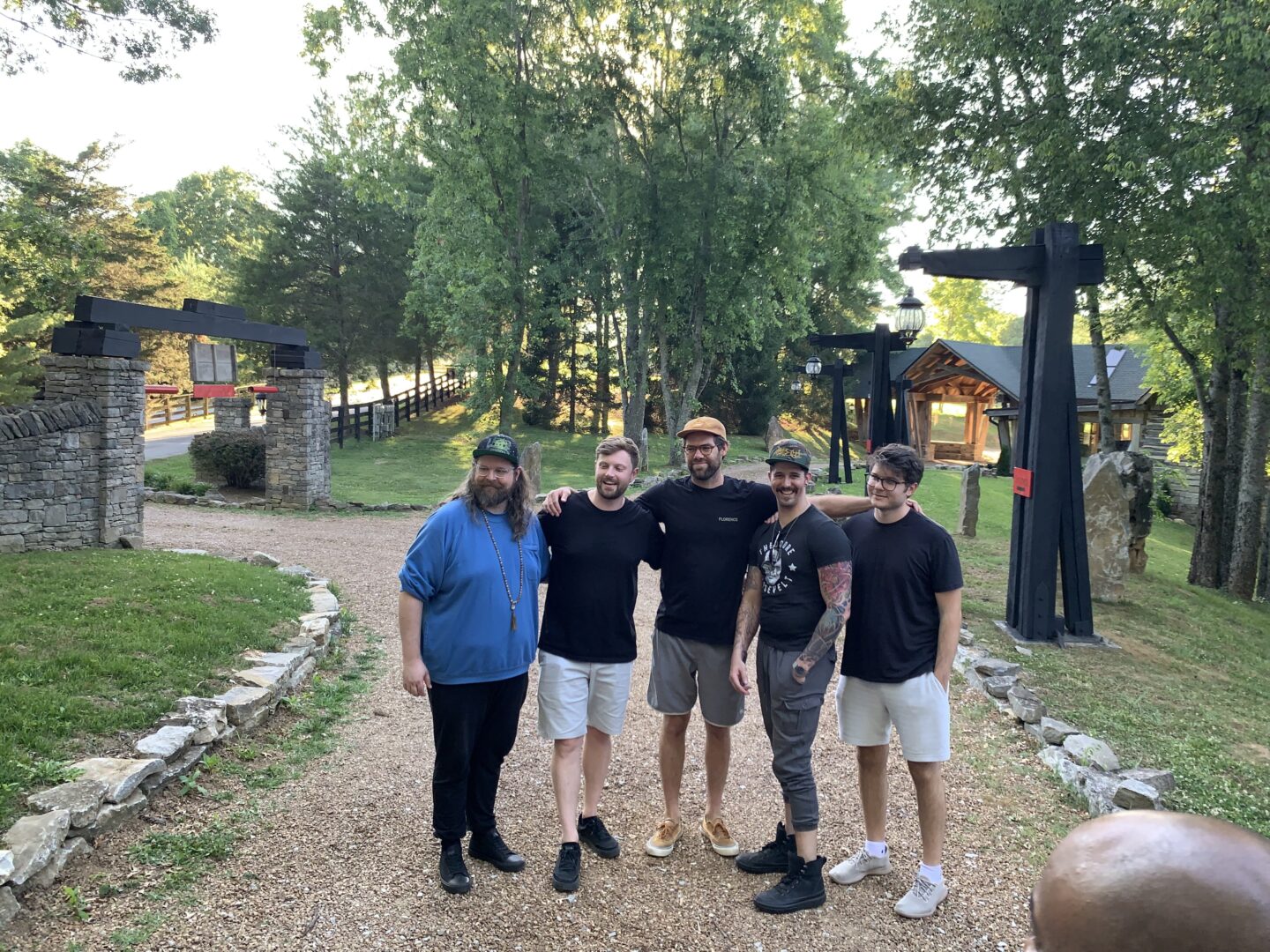
The Mentors of Mastering.com L-R: Caleb Loveless, Rob Mayzes, Dane Holmes, Jake Kodweis, Michael Gilbride
The Mentors of Mastering.com
L-R: Caleb Loveless, Rob Mayzes,
Dane Holmes, Jake Kodweis,
Michael Gilbride
— Dark Horse Recording, June 24, 2024
Photo: yours truly
Upstairs at Toronto’s legendary El Mocambo with Afraid To Dance, 1984
Photo: from video by Ron Shaw

As a person who has studied teaching and learning in some depth (M.Ed. York University, 2013) the highly effective “outcomes based” nature of the program captured my attention from the start. Working “backwards” from mastering to production makes perfect sense, and mimics the way we solve many math and other “problems.” Once in, I found this attention to mindset and process is maintained throughout the curriculum. I asked Caleb Loveless, Director of Education at Mastering.com, about his background. It wasn’t an interview and there’s no transcript: I concluded he’s simply a natural, who not only loves what he does but is excited to share what he knows and, like every other result of proven process approached consistently with this mindset, has arrived at an efficient and effective way to get the results he imagined.

Richard, July 4th, 2023 Photo: moi

When I joined TRE, releasing decent-sounding music of my own was all I envisioned. And yet I’ve gained the ability to mix and master for others, and a whole new perspective on the modern music industry. A realistic one. I knew my feet had found their way back to my life’s true path. I did not anticipate becoming a full stack producer—because I lacked a process and mindset, and lurked in the shadows.

If you want to hear what else they’ve unleashed in me just stick around. If you or anyone you know wants to learn how to produce music—as a lifestyle—don’t wait another minute: The Reverse Engineer.

It is the business and policy of traitors, so to disguise their treason with plausible names, and so to recommend it with popular and bewitching colours, that they themselves shall be adored, while their work is detested, and yet carried on by those that detest it.


—John Trenchard
   (Cato’s Letter No. 17. Saturday, February 18, 1721 — What Measures are actually taken by wicked and desperate Ministers to ruin and enslave their Country.)

May these New Dark Ages soon pass!

Page 1 of 2

Powered by WordPress & Lovecraft Child theme by GuitarFaces
based on Lovecraft by Anders Norén
Privacy Statement